The Gita's Sankhya Yoga: Krishna's Teaching on the Immortality of the Soul
On this page
- Why It's Called Sankhya Yoga
- The Argument Starts With a Rebuke
- Never Was There a Time I Was Not
- Worn-Out Garments
- Neither Cut, Nor Burned, Nor Wetted, Nor Dried
- A Teaching Krishna Didn't Invent Here
- The Argument Krishna Actually Wants Arjuna to Notice
- The Man of Steady Wisdom
- The Chain That Leads From a Thought to a Fall
- Established in Yoga, Perform Action
- What the Argument Is Actually For
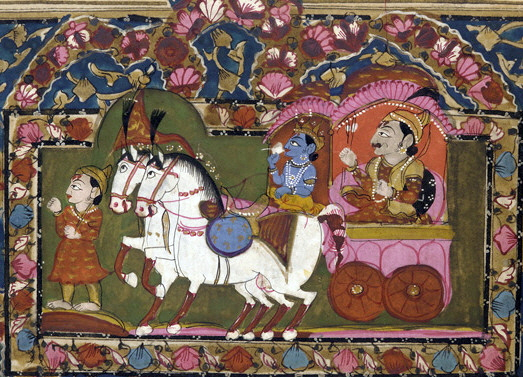
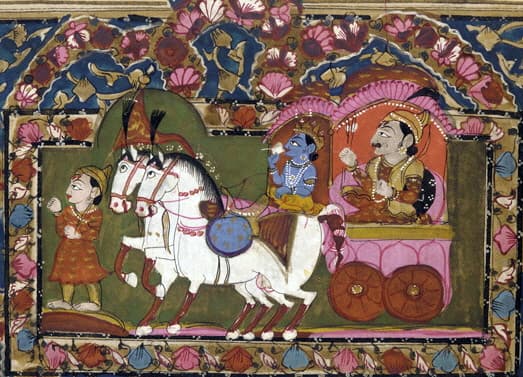
The Bhagavad Gita's first chapter ends with Arjuna physically collapsing — bow dropped, mind reeling, refusing to fight a war against his own teachers and kinsmen. It's a raw, specific grief, not a philosophical position. What's easy to miss on a first reading is that Krishna doesn't respond to that grief with a discussion of duty, or war, or dharma, at least not at first. Chapter 2 — known as Sankhya Yoga — opens instead with an argument about what a person actually is, made before any argument about what a person should do. Krishna's claim is that Arjuna's entire crisis rests on a mistaken premise about who is going to die, and until that premise is corrected, no argument about duty could possibly land.
Why It's Called Sankhya Yoga
The chapter's title refers to Sankhya, one of the oldest systems of Indian philosophy, built around a sharp analytical distinction between purusha (pure consciousness, the witnessing self) and prakriti (matter, including the body, mind, and senses). Calling this chapter "Sankhya Yoga" signals what kind of argument is coming: not a devotional appeal, not a rulebook, but a piece of careful metaphysical reasoning about which side of that distinction a person actually belongs to. Krishna is using Sankhya's analytical tools to answer Arjuna's grief with a claim about ontology — what is real and unreal, what can and cannot be destroyed — before turning, later in the same chapter, to what to actually do about it.
The Argument Starts With a Rebuke
Krishna's opening words to Arjuna are unusually direct for a text about to deliver its central philosophical teaching: he tells Arjuna his sorrow is unbecoming of someone who claims to understand these matters, that it leads neither to a higher state nor to honor, and asks him not to yield to this "unmanly weakness." It's a striking way to begin — not consolation, but a kind of bracing challenge, treating Arjuna's grief as a lapse in understanding rather than an emotion to be soothed. That framing matters for reading everything that follows: Krishna isn't offering Arjuna comfort. He's offering him a correction.
Never Was There a Time I Was Not
The core claim arrives quickly and is repeated with real insistence: "Never was there a time when I did not exist, nor you, nor these kings; nor in the future shall any of us cease to exist." The self that Arjuna is grieving over — his own, his teachers', his kinsmen's — didn't come into being at birth and won't go out of being at death, according to this claim. What dies is the body; what Arjuna is actually mourning, understood correctly, was never on the table to lose.
Krishna extends the point with an image of ordinary continuity that anyone can verify from their own life: "As the embodied soul continuously passes, in this body, from boyhood to youth to old age, the soul similarly passes into another body at death." The argument leans on something Arjuna already accepts without difficulty — that the person occupying a body at forty is, in some meaningful sense, the same self that occupied a very different-looking body at four, despite every cell and feature having changed. Krishna's claim is that death is a continuation of exactly that same kind of transition, not a categorically different event that ends the self rather than relocating it.
Worn-Out Garments
The verse that follows gives this claim its most quoted image: "As a person casts off worn-out garments and puts on others that are new, so the embodied soul casts off worn-out bodies and enters into others that are new." It's worth noticing what this metaphor does and doesn't claim. It isn't arguing the body doesn't matter, the way a careless reading might take it — nobody treats worn-out clothing as worthless while wearing it; it still serves its purpose for as long as it's worn. The claim is narrower and more specific: identity tracks the wearer, not the garment, and changing garments is not equivalent to the wearer ceasing to exist.
Neither Cut, Nor Burned, Nor Wetted, Nor Dried
Krishna pushes the description of the self further in one of the chapter's most physically vivid verses, describing the atman as something weapons cannot cut, fire cannot burn, water cannot wet, and wind cannot dry — calling it eternal, all-pervading, unchanging, immovable, and primordial. It's worth being precise about what kind of claim this is. It isn't a claim about the body's physical durability — bodies obviously can be cut, burned, and destroyed, and the Gita never disputes that. It's a claim that whatever is doing the actual experiencing, the witness inside the body that these events happen to, isn't itself a physical object with a surface that could be cut or a composition that could burn. The imagery is deliberately drawn from the most violent and elemental forces available — the actual weapons of the battlefield Arjuna is standing on — which is exactly the point: even the most extreme physical destruction imaginable, Krishna is saying, doesn't reach the thing Arjuna is actually grieving for.
A Teaching Krishna Didn't Invent Here
It's worth being direct about something the Gita itself doesn't flag explicitly: this argument, and even much of its specific phrasing, isn't original to this battlefield conversation. Centuries earlier, the Katha Upanishad has Yama teach Nachiketa, almost word for word, that the self is not born and does not die, is not slain when the body is slain, is unborn, eternal, and ancient. The Gita's version in this chapter — na jayate mriyate va kadacit — is close enough to the Upanishad's na jayate mriyate va vipascit that most scholars treat the Gita as directly drawing on this older teaching rather than arriving at the same wording independently. That's worth knowing not as a mark against the Gita's originality but as a clue to how to read it: the text is presenting itself, and was likely understood by its earliest audience, as restating an already-established Upanishadic teaching at the moment it's needed most — in the middle of a crisis, from a friend, rather than in a forest dialogue with Death.
The Argument Krishna Actually Wants Arjuna to Notice
After building the metaphysical case, Krishna makes an argument that's easy to read past because it sounds almost like a concession: even if you don't accept any of this, he tells Arjuna, even if you think the self is repeatedly born and repeatedly dies, you still have no grounds for this grief — because what is born must die and what dies must be born again, and grieving over what cannot be avoided makes no sense either way. This is a genuinely careful piece of argument construction: Krishna isn't resting his entire case on Arjuna accepting a specific metaphysical claim about the eternal soul. He's showing that Arjuna's grief doesn't hold up under either available framework — the eternalist one Krishna has just laid out, or the more ordinary, mortalist one Arjuna might privately still hold. Both roads lead to the same practical conclusion.
The Man of Steady Wisdom
The chapter's second half shifts from what the self is to what a person who has genuinely absorbed this teaching would actually look like, in a long, closely observed portrait Krishna gives in response to Arjuna's direct question: what are the marks of someone whose wisdom is steady, who sits absorbed in that understanding? Krishna answers slowly, verse by verse, describing someone who has abandoned every desire that arises purely from the mind and is content in the self alone; who isn't shaken in adversity, doesn't crave pleasure, and has let go of attachment, fear, and anger; who is unaffected by what's pleasant or unpleasant, and neither rejoices at getting something desirable nor recoils from something undesirable.
The most physically concrete image in this section compares such a person's control over the senses to a tortoise drawing its limbs in from every side — a specifically chosen image because it depicts something other than either extreme people usually assume is the only alternative to being ruled by desire. A tortoise's withdrawal isn't the senses being severed or destroyed; it's a capacity the animal has and exercises at will, retracting when it chooses to and extending again when it chooses to. The sthitaprajna, in this description, isn't someone who has become numb to the senses. It's someone who has gained the same kind of at-will command over them that the tortoise has over its limbs — able to engage fully and withdraw fully, rather than being dragged around by whichever sense happens to be pulling hardest at a given moment.
Krishna adds a warning to this description that keeps it from sounding like a static achievement: even for someone practicing restraint, the senses can still forcibly carry away the mind of even a wise person who is striving toward the goal. The teaching isn't describing a switch that gets flipped once and stays flipped — it's describing a capacity that has to be actively held, the same caution the Katha Upanishad gives when it warns that the yoga it describes can be gained and lost, and calls for continued vigilance even after it's attained.
The Chain That Leads From a Thought to a Fall
One of the chapter's most quoted passages traces a precise causal sequence, verse by verse, from a single dwelt-upon thought to a person's complete downfall: dwelling on sense objects gives rise to attachment; attachment gives rise to desire; frustrated desire gives rise to anger; anger produces delusion; delusion causes confused memory; confused memory destroys discrimination (buddhi); and the destruction of discrimination destroys the person entirely. It's presented as a chain rather than a single leap specifically because the intervening links are where the whole sequence can still be interrupted — the teaching isn't "never think about anything," an impossible standard, it's a map of exactly where a thought that starts out neutral turns into something that actually costs a person their judgment, so the chain can be recognized and broken partway through rather than only after the damage is done.
Established in Yoga, Perform Action
Toward the end of the chapter, Krishna begins turning from pure metaphysics toward practice, in a shift that sets up the fuller teaching on selfless action the Gita develops later: "Perform your duty established in yoga (yogasthah), abandoning attachment, and remain the same in success and failure. This evenness of mind is called yoga." He follows this with what becomes one of the most quoted single lines in the entire text: a person of steady wisdom, even here in this life, has conquered both good and evil, because such evenness of mind is itself the mark of that steadiness. This passage is doing careful transitional work — the chapter opened by dismantling Arjuna's premise about the self, and it closes by pointing toward the actual instruction for how to act once that premise has actually been dismantled, without yet spelling out the full doctrine of nonattached action the Gita takes up at length afterward.
What the Argument Is Actually For
It's worth stepping back from the individual verses to notice what kind of argument chapter 2 as a whole actually is. It isn't a stoic instruction to simply stop feeling things, and it isn't a denial that death, loss, and grief are real events with real weight in a life. Krishna's argument is narrower and more specific than either of those readings: that the self a person actually is — the witnessing awareness behind the body's changes, described here as uncuttable, unburnable, and unchanging — is not the kind of thing that a sword, a fire, or the ending of a body could touch. Arjuna's grief, on this argument, isn't wrong because grief itself is wrong; it's misdirected, aimed at a loss that, correctly understood, isn't the loss actually taking place. Everything the Gita builds in the sixteen chapters that follow — the teaching on selfless action, on devotion, on meditation — is built on top of this specific claim, made first, before any of it: that the person asking "should I fight" and the person Arjuna is afraid of losing were never, in the terms this chapter lays out, at risk of ending in the first place.

Written by Ravindra Valand
Part of AnuSutra's editorial team, writing sourced, fact-checked guides on spiritual healing and wellness.