Om: What the Mandukya Upanishad Actually Says About the Sacred Syllable
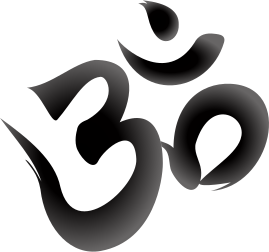
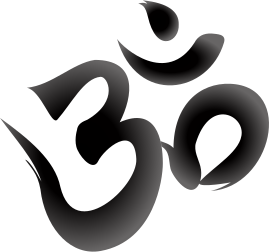
Om gets treated, in a lot of casual spiritual content, as a pleasant sound to chant at the start or end of a yoga class — meaningful in a vague, atmospheric way, rarely explained beyond "it's an ancient sacred syllable." The actual textual source most responsible for Om's philosophical weight is a specific, remarkably short Upanishad that uses the syllable's own structure as a literal map of the entire range of human consciousness, and then points beyond that map entirely.
The Shortest Upanishad in the Classical Canon
The Mandukya Upanishad, associated with the Atharvaveda, is only twelve verses long — the shortest of the principal Upanishads by a wide margin, and yet it's treated by later tradition, particularly the Advaita Vedanta school, as one of the most philosophically important, dense enough that a considerable body of commentary has grown up around a text you could read aloud in a few minutes. Its opening line states the thesis the rest of the text exists to unpack: Om is everything — the entirety of the past, present, and future, and whatever else exists beyond the reach of time altogether, all of it is Om.
Three Letters, Three States of Consciousness
The Upanishad's actual method for unpacking that claim is to break the syllable Om (written in Sanskrit as three sounds, A-U-M) into its component parts and match each one to a specific, ordinary state of consciousness every person actually experiences.
A, the opening sound, corresponds to the waking state — ordinary consciousness directed outward toward a shared external world, called Vaishvanara in the text. U, the middle sound, corresponds to the dream state — consciousness turned inward, experiencing a private, self-generated world of mental imagery, called Taijasa. M, the closing sound, corresponds to deep, dreamless sleep — a state without the differentiated content of either waking or dreaming, but not therefore empty or unconscious in the text's own account; it's described as a unified, undifferentiated mass of consciousness, called Prajna, that has simply stopped generating distinguishable objects of experience for the time being.
This mapping alone is a genuinely notable piece of early systematic psychology — attaching a specific letter of a sacred syllable to a specific, universally recognizable state of consciousness, rather than treating Om as a single undifferentiated symbol. But the text's most distinctive move comes next, in what it does with the syllable after the three letters are spoken.
The Fourth State: What's Left When the Sound Ends
After A, U, and M comes silence — and the Mandukya Upanishad treats that silence not as an absence, but as the most important part of the whole syllable. This is turiya, literally "the fourth" — a state of consciousness beyond waking, dreaming, and deep sleep, not simply another item in the same list but the underlying awareness present through and beneath all three of the others, the way silence is present through and around the three spoken sounds without itself being a fourth sound. The text describes turiya as without parts, beyond ordinary sensory experience, peaceful, and non-dual — the ultimate nature of the self, identical to Om taken as a whole rather than as three separate letters.
The structure here is worth being explicit about, because it's easy to miss: the Upanishad isn't claiming turiya is a rare, exotic fourth state accessible only to advanced practitioners in deep meditation. It's presented as always already present, underlying the other three ordinary states every person cycles through daily, waking to dreaming to deep sleep and back again — the goal of the teaching is recognizing what's already there beneath the three familiar states, not manufacturing a new experience from scratch.
The Commentary That Turned Twelve Verses Into a Full Philosophy
The Mandukya Upanishad's brevity is part of why it needed, and received, substantial early commentary to be fully unpacked — most significantly the Gaudapada Karika, a verse commentary attributed to Gaudapada, traditionally identified as the teacher of Shankara's own teacher, making it one of the earliest systematic expositions of Advaita (non-dual) Vedanta philosophy to survive, predating Shankara's own much more famous commentaries. Gaudapada's text takes the Upanishad's compact fourfold analysis of consciousness and builds a considerably more developed philosophical argument around it concerning the ultimate non-difference between waking and dreaming experience, and between the individual self and ultimate reality — the same core claim already covered in this series' piece on Atman and Brahman, approached here through the specific lens of ordinary, everyday shifts in conscious state rather than through parable or direct declaration.
Why Starting From Ordinary Experience Is the Actual Point
What makes the Mandukya Upanishad's specific approach worth knowing, distinct from the other Upanishadic teachings on the self already covered in this series, is where it starts: not with abstract metaphysics or a teaching story, but with the three states of consciousness every single person, without exception, already moves through every day. Waking, dreaming, and dreamless sleep aren't rare mystical achievements — they're the most mundane, universal facts of having a mind at all. By building its entire argument for a "fourth," underlying state directly out of that shared, everyday experience, the text is making an unusually accessible philosophical move for material this old: rather than asking a reader to first accept an unfamiliar metaphysical claim on faith, it starts from something the reader is already, necessarily, intimately familiar with, and asks them to notice what's actually present underneath the familiar categories they've never had reason to examine before.

Written by Ravindra Valand
Part of AnuSutra's editorial team, writing sourced, fact-checked guides on spiritual healing and wellness.